免责声明: This article is published by Paydibs and is provided for general informational purposes only. It does not constitute technical, financial, or legal advice. Payment features and integration outcomes may vary depending on the solution and implementation. Businesses should refer to the official Paydibs documentation and seek appropriate professional guidance before implementing any payment solution.
B2B commerce, wholesale trade, and professional service agencies in Malaysia have traditionally handled collections through direct corporate bank transfers. While this manual method avoids consumer credit card processing fees, it introduces severe operational drag.
The standard workflow typically requires a buyer to execute an interbank transfer, download a PDF or take a screenshot of the transaction receipt, and send it to the seller via email or WhatsApp. The seller’s finance team must then manually log into their corporate banking portal, match the receipt against the bank statement, and manually update the company’s accounting software or Enterprise Resource Planning (ERP) ledger before releasing goods or provisioning services.
As transaction volumes scale, this manual approach strains administrative resources. Consequently, the commercial market is adopting consumer-style payment patterns. By integrating modern B2B payment solutions in Malaysia, business-to-business operators are replacing manual verification with automated checkout infrastructure that mirrors the simplicity of retail e-commerce.
1. Digitising the Corporate Counter: B2B Gateway Infrastructure
The primary objective of modernising B2B payments is to establish an immediate, programmable link between a buyer’s payment action and a seller’s order system. Implementing a dedicated online banking gateway for corporate transactions allows wholesalers and service providers to embed secure payment options directly into digital invoices, client portals, or procurement platforms.
When a corporate buyer initiates an order, the system generates a structured transaction path. Rather than executing an unverified bank transfer, the buyer clears the balance via integrated payment rails, such as FPX (which supports company/corporate accounts) or other approved online banking methods, subject to each bank’s transaction limits.
This architectural change shifts the collection model from a reactive process to an automated, self-contained loop:
[System Generates Digital Invoice] → [Buyer Pays via Secure FPX/Card Link] → [Gateway Issues Instant Verification]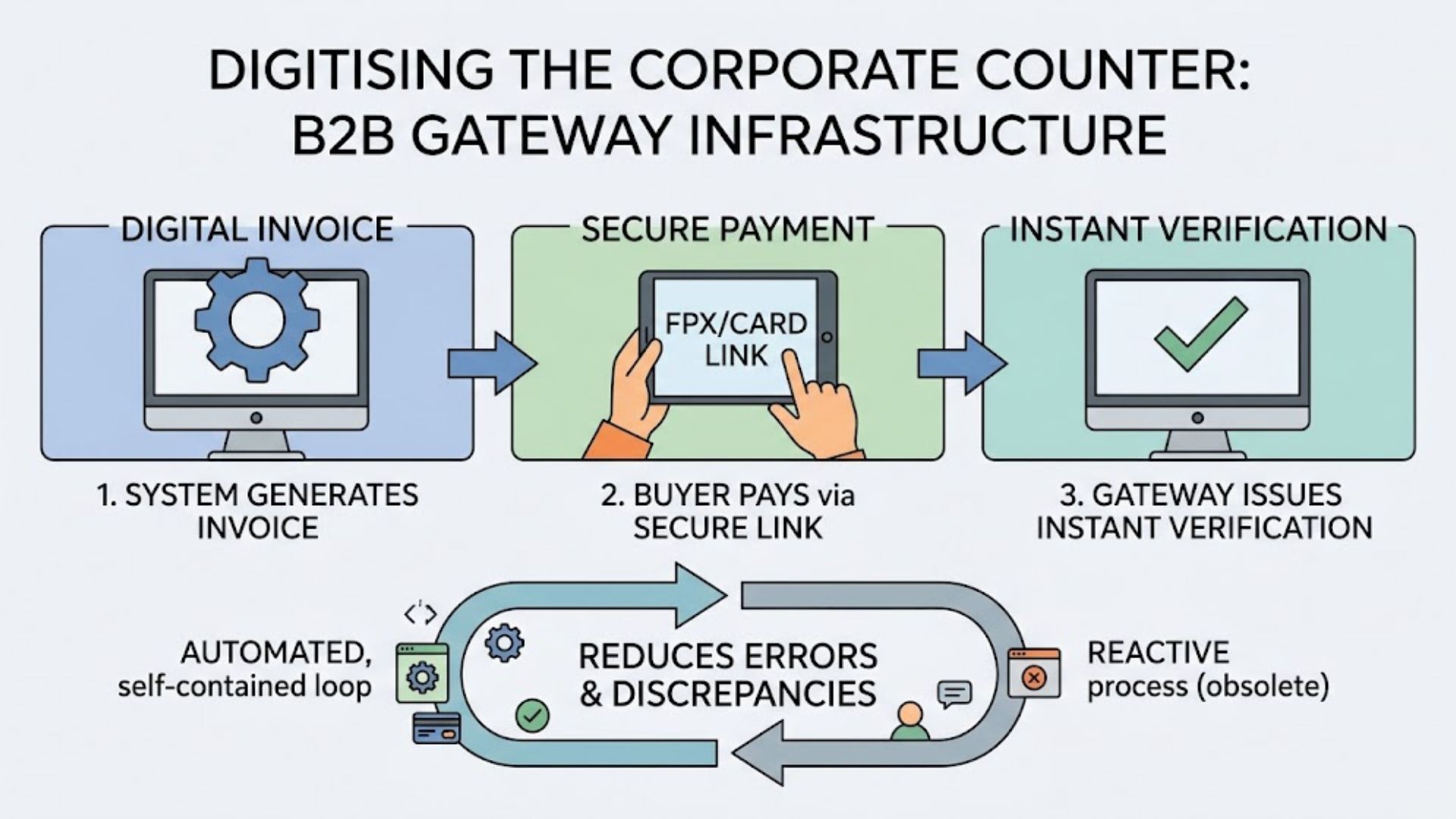
The gateway can provide payment status updates to the seller’s system after a transaction is processed, while settlement and payout continue to follow the standard schedule of the payment provider or acquiring bank. This can help reduce payment reconciliation issues and minimise manual data-entry errors during the checkout process, depending on the merchant’s system configuration and workflow.
2. Real-Time Reconciliation and Cash Flow Velocity
For mid-market enterprises and growing SMEs, the largest hidden cost of manual payments is administrative overhead. A payment gateway solution addresses this through real-time API callback webhooks that drive automated payment reconciliation.
When a transaction succeeds, the payment engine immediately pushes a structured data payload back to the merchant’s backend server. This single data transmission handles multiple financial tasks automatically:
- Instant Ledger Updates: Automatically updates the status of the specific invoice from “Pending” to “Paid” inside the company’s accounting or ERP software.
- Order Release Triggers: Signals the warehouse management system or SaaS provisioning engine to dispatch goods or unlock accounts instantly, reducing delivery delays.
- Optimised Settlement Schedules: Transactions routed through a structured integration may follow T+1 or T+2 payout cycles (depending on the provider, acquirer, and approval terms), supporting more predictable cash-flow planning.

3. The Compliance Mandate: Connecting Payments to LHDN e-Invoicing
In Malaysia’s regulatory landscape, payment modernisation is closely linked to national compliance initiatives. The ongoing rollout of mandatory electronic invoicing by the Inland Revenue Board of Malaysia (LHDN / Lembaga Hasil Dalam Negeri) requires strict data accuracy for commercial transactions. Based on LHDN’s published timeline (updated 7 December 2025), taxpayers with annual turnover or revenue up to RM5 million move into mandatory e-Invoicing from 1 January 2026. LHDN guidance also outlines MSME exemption and concession scenarios where applicable.
It is critical to understand that a payment gateway receipt, a banking confirmation page, or a credit card slip does not legally constitute a valid tax invoice. Under local regulations, an e-invoice must be generated by the seller, contain explicit mandatory tax fields (such as Tax Identification Numbers and MSIC codes), and be transmitted programmatically via the MyInvois API or portal to LHDN’s system for official validation.
However, a modern gateway serves as the vital foundation for e-invoicing compliance LHDN. By providing clean, unique transaction IDs, consistent reference markers, and precise timestamps, a structured payment gateway enables automation software to effortlessly match validated LHDN e-invoices with actual cash receipts. This robust audit trail minimises compliance risks during future corporate tax audits.
结论
Manual bank transfers and screenshot-based “proof of payment” might feel familiar in Malaysian B2B trade, but they don’t scale cleanly. As wholesale order volumes grow and as e-Invoicing requirements raise the bar on data accuracy, finance teams need payment flows that connect the moment funds are authorised to the moment an invoice is cleared, goods are released, and records are updated.
The practical path forward is simple: move collections from “manual confirmation” to structured, reference-driven payments with automated status callbacks. When payments, invoice references, and timestamps are captured consistently, reconciliation becomes faster, exceptions become easier to spot, and e-Invoice matching becomes far less painful.
If you’re planning to modernise your B2B collections, look for a payment service provider that supports Malaysia’s online banking rails, provides clean API/webhook events, and fits into your invoicing and ERP stack, so your team spends less time chasing receipts and more time moving orders.