Disclaimer: This article is published by Paydibs and contains promotional content. It is for general informational purposes only and does not constitute technical, financial, or regulatory advice. Businesses should refer to official documentation and seek professional advice before making security or integration decisions.
The expansion of digital commerce in Malaysia requires robust risk controls. As businesses process higher volumes of digital transactions via credit cards, e-wallets, and online banking, they encounter diverse digital payment risks. These include card testing bots, account takeovers (ATO), and false chargeback claims.
For e-commerce merchants, managing these issues involves balancing transaction security with customer experience. Restrictive security rules can result in cart abandonment from legitimate buyers, while loose security parameters expose a business to chargeback fees, inventory losses, and regulatory oversight.
Technical Architecture: Card Testing vs. Friendly Fraud Risk Profiles
Different risk vectors require specific mitigation mechanisms. Understanding how typical transaction risks operate at checkout helps merchants identify anomalies early.
Fraud/Risk Type | Operational Mechanism | Direct Impact on Merchant |
Card Testing Bot Attacks | Automated scripts process batches of stolen card data through small value transactions to verify validity. | Excessive gateway processing fees, system lag, and potential compliance flags. |
Friendly Fraud / Dispute Abuse | A legitimate account holder falsely disputes a completed transaction, claiming non-receipt or non-authorisation. | Immediate fund reversals, lost physical inventory, and processing penalty fees. |
Account Takeover (ATO) | Malicious entities gain unauthorised entry into verified user profiles, using stored payment tokens. | Chargebacks, brand trust erosion, and data protection/compliance exposure if personal data is compromised or mishandled. |
Technical Evaluation: How Gateway Risk Engines Assess Transactions
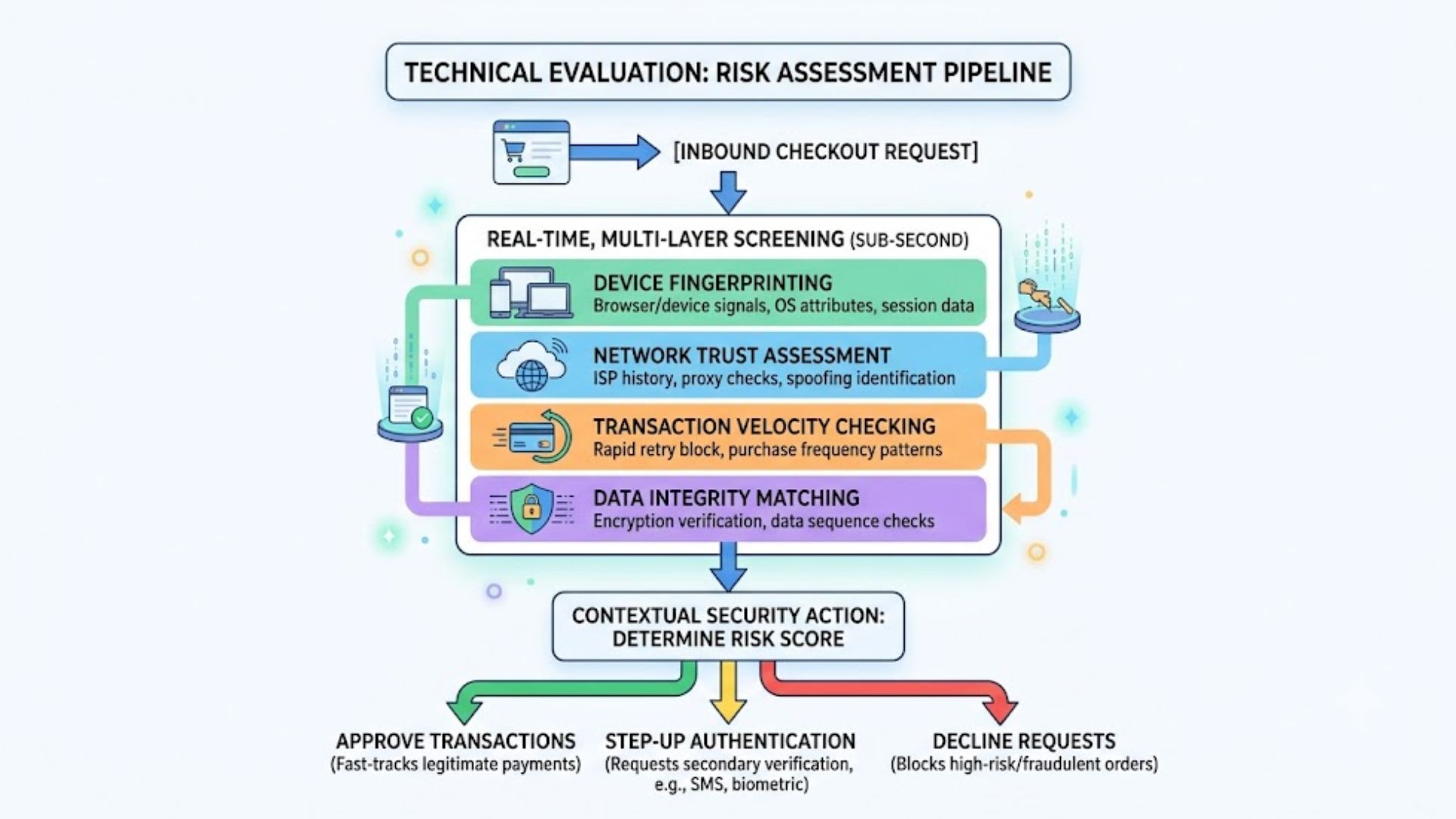
To protect checkout flows without creating manual bottlenecks, modern security platforms rely on real-time evaluation layers. When a payment request reaches the payment gateway, it is evaluated through a parallel screening pipeline before authorisation is requested from the acquiring bank.
By analysing device indicators, metadata, and past behavior patterns rapidly, the risk infrastructure establishes a contextual risk score. This data matching helps identify bots or spoofed network paths without altering the user interface for authentic customers.
Implementing Risk-Based Authentication (RBA) via 3DS2
Maintaining a high checkout conversion rate requires adaptive security protocols rather than static blocks. Paydibs supports 3-D Secure 2 (3DS2), which incorporates issuer-driven risk-based authentication to enable frictionless authentication for low-risk transactions while challenging higher-risk transactions when additional verification is required.
- Low-Risk Pathways: Transactions that match standard buyer profiles (such as using a recognised device, a verified domestic network, and typical purchasing amounts) flow smoothly through the checkout system. This friction-free path maintains conversion metrics.
- High-Risk Pathways: If a transaction displays anomalies (such as multi-country geolocation mismatches or unexpected rapid card switching), the system triggers a secure verification layer.
- 3DS2 Step-Up Verification: Instead of declining the user instantly, the platform deploys mobile-optimised 3DS2 protocols. The buyer completes the purchase using such as bank app approval, OTP, or biometric authentication depending on issuer flow, providing a path for authentic transactions while blocking unauthorised checkout manipulation.
Compliance Frameworks: BNM Guidelines and PCI-DSS Protocols
Operating a secure online payment channel in Malaysia demands adherence to domestic and global operational regulations.
- Bank Negara Malaysia (BNM) regulatory framework: Regulated entities (e.g., merchant acquirers and payment services regulatees) are expected to follow BNM requirements on operational/technology risk controls and transaction monitoring/AML controls, as set out in relevant BNM policy documents.
- PCI-DSS compliance: Payment gateways operate under the Payment Card Industry Data Security Standard (PCI-DSS) framework to secure card data. PCI rules require strong protection of stored and transmitted cardholder data, and sensitive authentication data (such as CVV, PIN, or full track data) must never be stored after authorisation, even if encrypted. Tokenisation is commonly used to reduce exposure, but implementation varies by provider.
- PDPA alignment: All customer data parsed during screening must be handled in conformity with the Personal Data Protection Act 2010, ensuring user privacy stays intact.
Operational Strategies for E-Commerce Risk Management
Merchants can strengthen their checkout systems by coordinating their internal store setups with payment gateway security tools:
- Monitor Storefront Velocity Metrics: Set rule alerts within your platform backend to detect unusual patterns, such as multiple failed checkout iterations coming from a single session identifier.
- Unify Channel Monitoring: Use a central merchant dashboard to view transactions across payment channels (including cards, DuitNow Online Banking, and e-wallets) to track consistent cross-channel trends.
- Deploy Tokenisation for Repeat Customers: Utilise tokenised checkout flows so returning users can pay via secure identification tokens instead of inputting primary card details repeatedly.
Summary
As security threats modernise, static checkout settings are no longer sufficient to safeguard digital retail payments. By adopting adaptive fraud prevention, real-time risk assessment, and properly implemented 3-D Secure 2 (3DS2), Malaysian businesses can help mitigate fraud risks while maintaining a seamless checkout experience for legitimate customers.