免责声明: This article is intended for general informational purposes only and does not constitute financial, tax, legal, or regulatory advice. Payment link features, supported payment methods, fees, and settlement terms vary by provider. Businesses should confirm details directly with service providers before use.
重点摘要
- Payment links allow businesses to collect funds via a unique URL shared through WhatsApp, email, or social media.
- They eliminate the need for a complex website or technical coding, making digital transitions accessible for smaller operations.
- Security remains a priority, with links directing customers to encrypted, 3D-secure gateways for transaction safety.
- The versatility of “Pay-by-Link” supports various scenarios, from professional services and invoices to social commerce orders.
- Operational efficiency improves as automated receipts and transaction tracking replace manual bank transfer slip verification.
In an era where a business deal is just as likely to happen over a WhatsApp chat as it is in a formal boardroom, the way we collect payments has had to evolve. For many growing businesses in the region, the traditional hurdles of setting up a full-scale e-commerce website can be daunting. The payment link has somehow emerged as the middle ground, a lightweight, secure, and incredibly flexible tool that turns any digital interaction into a point of sale.
How Does a Payment Link Work?
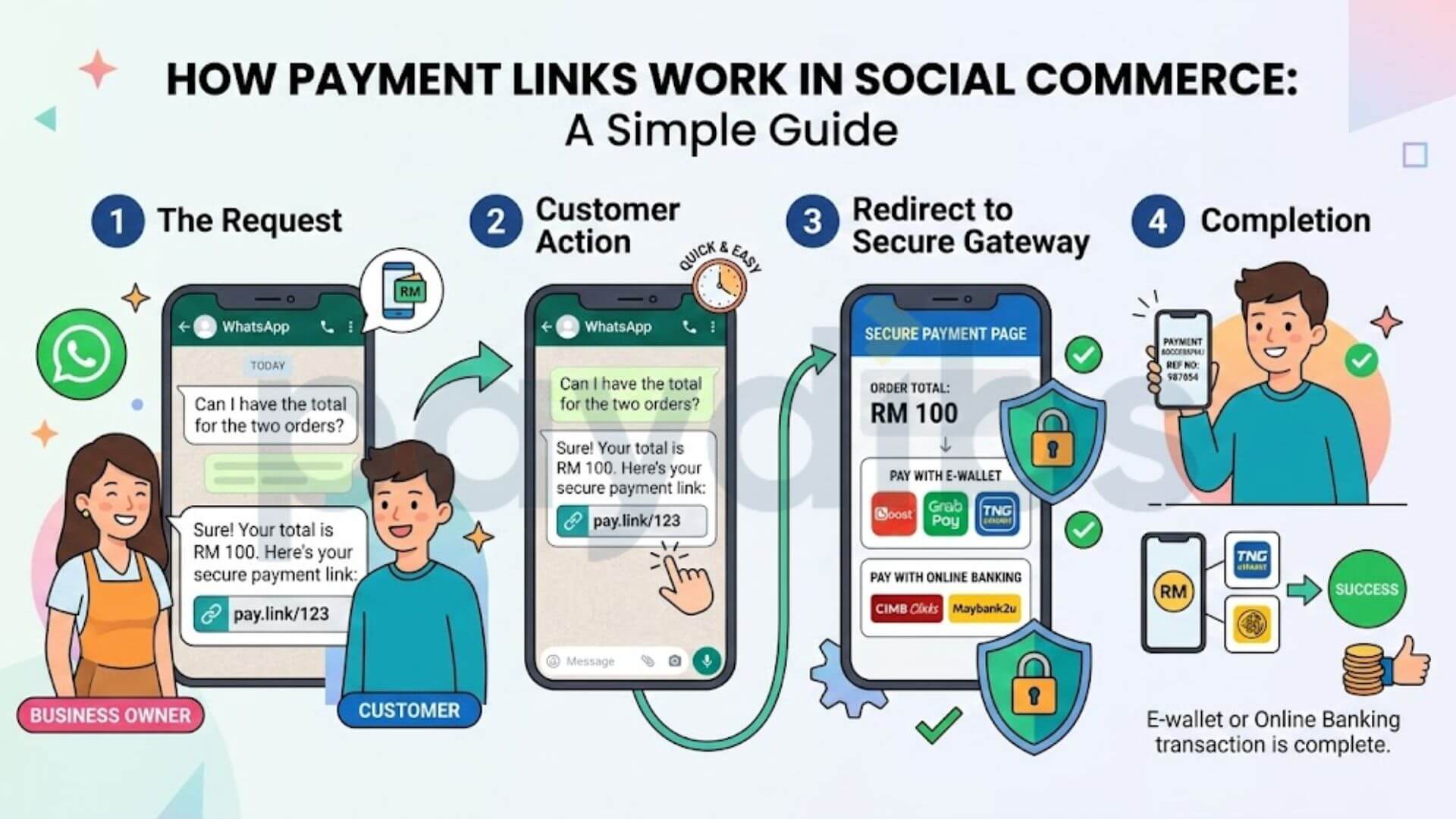
A payment link is essentially a “digital invoice” in the form of a URL. Once generated, it can be sent to a customer through any communication channel. Clicking the link takes the user to a secure hosted page where they can choose their preferred payment method, be it credit card, e-wallet, or FPX online banking to complete the transaction instantly.
Feature | Bank Transfer (Manual) | Payment Link | Full E-commerce Site |
Setup Speed | Instant | Minutes | Weeks/Months |
Trust Level | Moderate (Manual slips) | High (Secure Gateway) | High (Branded) |
Customer Effort | High (Manual entry) | Low (Few clicks) | Low (Self-service) |
Reporting | Manual Reconciliation | Automated Dashboard | Automated Dashboard |
Transaction Fees | Low/None | Percentage-based | Percentage + Subscription |
What is a Payment Link in the Current Digital Economy?
A payment link acts as a secure shortcut that bypasses the need for traditional checkout carts.
While the concept sounds simple, the technology behind it is robust. Instead of asking a customer to manually type in a bank account number and then “screenshot the receipt,” a payment link automates the entire flow. The link carries the specific transaction details, ensuring the amount is pre-fixed, which reduces human error on both ends.
In the local context, where mobile penetration is exceptionally high, this “request-to-pay” model aligns perfectly with how people spend their time. Whether it’s a boutique owner selling on Instagram or a consultant billing for a monthly retainer, the ability to generate a link on the fly means the “buying momentum” is never lost.
Why Are Businesses Moving Away from Manual Bank Transfers?
Manual verification of bank slips is a significant “hidden” labor cost for growing enterprises.
For a business handling five orders a day, checking a bank app for incoming funds is manageable. At fifty orders a day, it becomes a nightmare. Payment links solve the “matching” problem. Because each link is tied to a specific order ID, the system knows exactly who paid for what the moment the transaction is successful.
Furthermore, the security aspect cannot be overstated. When a customer pays via a link powered by a regulated payment provider, they are protected by standard encryption protocols. This builds a layer of professional legitimacy that a simple “DM for bank details” cannot provide.
How Do Payment Links Support Social Commerce?
Integrating payment links into chat platforms turns conversations into confirmed revenue.
Social commerce selling via Facebook, TikTok, or WhatsApp is a pillar of the local economy. However, the biggest friction point in these channels is the “last mile” of the sale. A payment link acts as the closing tool.
Consider a specialized bakery. A customer asks about a custom cake via WhatsApp. The bakery sends the price, the customer agrees, and the bakery sends a payment link immediately. The customer pays using their preferred e-wallet without ever leaving the chat environment. This immediacy is what defines modern retail.
What Are the Technical Requirements for Implementation?
One of the greatest advantages of pay-by-link technology is the near-zero barrier to entry.
Unlike integrated APIs that require a software developer, payment links are typically generated via a merchant dashboard.
- Account Setup: Register with a payment service provider.
- Input Details: Enter the amount and a brief description (e.g., “Order #1234”).
- Generate & Share: Copy the unique URL and send it to the client.
This simplicity allows businesses to remain agile. It is particularly effective for “B2B” services where prices are negotiated and vary from client to client, making a fixed “Add to Cart” button on a website impractical.
Are Payment Links Secure for Both Parties?
Regulated payment gateways ensure that every link complies with global security standards.
Security is the most common concern for those transitioning to digital payments. Modern payment links utilize 3D Secure 2.0 (the system that sends an OTP to your phone) and are PCI-DSS compliant. This means the merchant never actually sees or stores the customer’s credit card or banking credentials.
For the merchant, the risk of “fake receipts” or photoshopped transaction screenshots is eliminated. The dashboard only marks an order as “Paid” once the funds are actually authorized by the financial institution.
How to Choose the Right Payment Provider?
The best partner is one that understands the local banking landscape and consumer habits.
When selecting a provider to power your payment links, look for a few specific criteria:
- Method Variety: Does it support the e-wallets and banks your customers actually use?
- Settlement Speed: How quickly is the money moved from the gateway to your business bank account?
- Dashboard Clarity: Can you easily see which links are pending, paid, or expired?
Selecting a provider with deep roots in the local ecosystem ensures that the payment page is familiar and localized for the user, which significantly reduces “cart abandonment” at the final stage.
Payment Link: A Growth Catalyst
The payment link is more than just a URL; it’s a statement of professionalism and efficiency.
As the market continues to move toward a “mobile-first” reality, the tools we use to facilitate trade must be equally portable. By adopting a link-based payment strategy, businesses can bridge the gap between traditional service and modern convenience, allowing them to focus on their craft rather than their paperwork.